
Thermoplastic Composites
Fusion Bonding
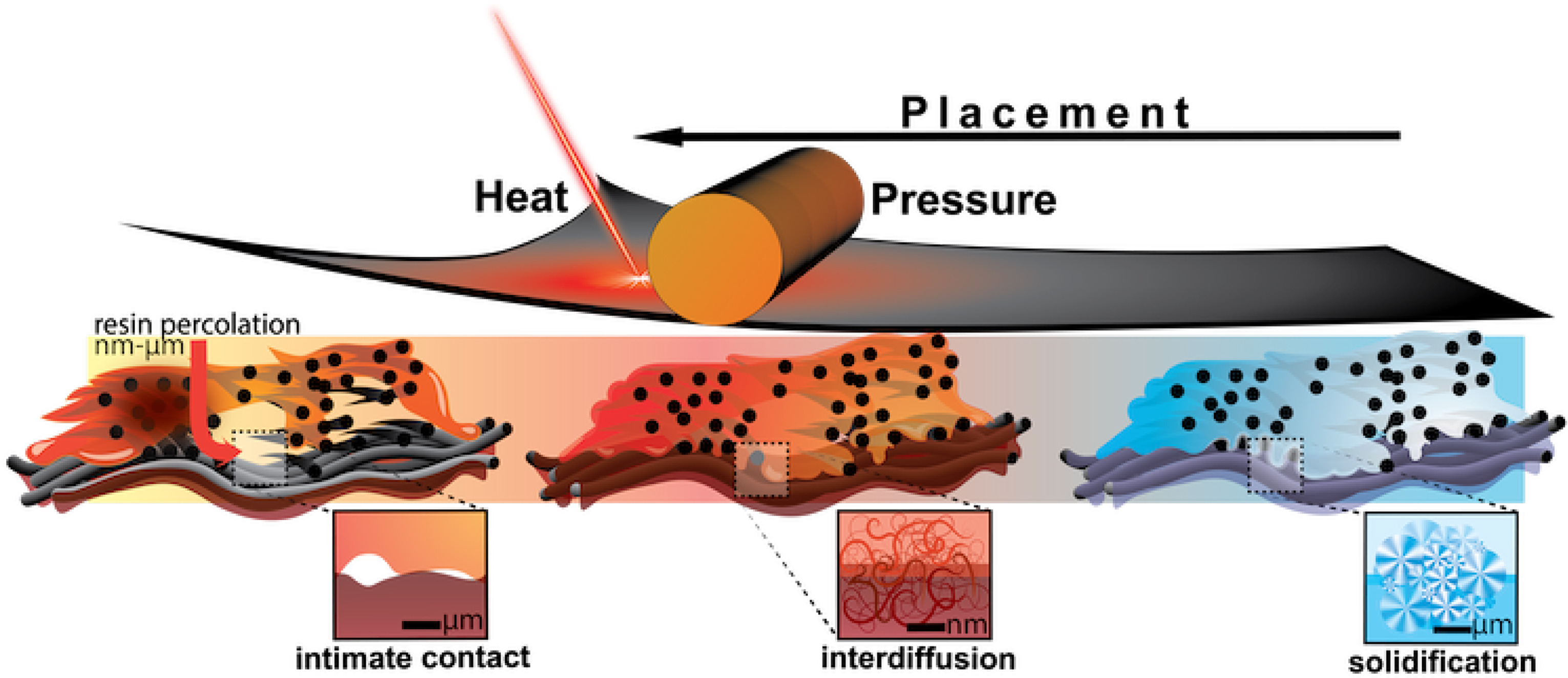
Thermoplastic fusion bonding governs the structural integrity of welded and in-situ consolidated composites. Bond formation depends on three coupled mechanisms:
- Intimate contact — pressure-driven resin flow and asperity collapse
- Interdiffusion — polymer chain interpenetration across the interface
- Crystallization — solidification that arrests further healing
In high-rate manufacturing, rapid cooling severely constrains this bonding window, making conventional melt-based processing both rate-limiting and energy intensive.
OATMEAL: Sub-Melt Consolidation
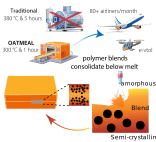
To decouple bonding from melt-processing constraints, Tyler Hudson (NASA Langley) and I developed OATMEAL (Out-of-autoclave Amorphous/Crystalline Thermoplastic Materials for Energy-Efficient Aerospace-Grade Laminates) — a thermoplastic carbon-fiber prepreg architecture that enables consolidation below the crystalline melt temperature.
OATMEAL uses a designed amorphous–crystalline interfacial architecture that allows bonding at 300 °C (≈80 °C below the PEEK melt point) without fully melting the bulk matrix. By preserving crystallinity while enabling interfacial healing, we unlock faster and more energy-efficient processing.
This approach enables:
- ~75% reduction in processing energy
- ~5× increase in production rates
- Vacuum-bag-only oven processing (no autoclave)
- Compatibility with fast cooling rates
Read the full paper in Advanced Materials:
Kirchhoff et al., Advanced Materials (2025)
Project news coverage and NASA CIF-iR&D support:
UT Austin News Article
Scaling & Integration
Ongoing work focuses on integrating OATMEAL into in-situ consolidation platforms (e.g., automated fiber placement) and scaling the technology for large aerostructure manufacturing.